Ending Erasure: The Struggle to Center Black Voices and Stories
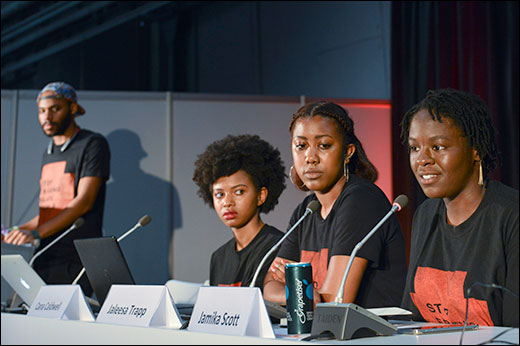
Tacoma Action Collective leaders Jamika Scott, Jaleesa Trapp, Cana Caldwell, Christopher Jordan discuss social protest and the erasure of Black people in the history of AIDS activism in the Global Village at the 2016 International AIDS Conference in Durban, South Africa. Photo: Freddie Allen
In what ways did non-White subgroups contribute to civilization? Iowa Congressman Steve King posed such a question during a recent appearance on MSNBC. The question is laughable, as civilization began in Africa. African Americans have not only helped build the nation—including, as Michelle Obama recently reminded many, the White House—but have also dramatically influenced American culture—from democracy itself (think: the Civil Rights Movement), to music (think: blues, jazz, rock, pop and hip-hop), to contributions in science and medicine (think: the gas mask, the blood bank and more).
But Congressman King's question wasn't framed as a joke. King was seriously questioning how "non-White sub groups", as he framed it, have contributed to society. Not only does his question reveal the blatant disregard many Americans have for the lives and accomplishments of people of color, it also underscores the erasure of African American contributions from U.S. history.
The topic of erasure was discussed during the #StopErasingBlackPeople: Social Protest in a Silent Crisis seminar at the 21st International AIDS Conference, led by members of the Tacoma Action Collective (TAC), a Tacoma, Washington-based group affiliated with the Black Lives Matter movement that works to eliminate systemic oppression and structural violence while empowering people to build autonomous communities rooted in equity and justice. Panelists challenged the erasure of Black voices from the history, activism and institutions of the AIDS movement, particularly since HIV/AIDS disproportionately affects Black people worldwide. In the U.S. African Americans make up only 12 percent of the population, but 44 percent of new HIV diagnoses. "More often than not, when talking about HIV/AIDS, Black voices and artistic expression are pushed from the spotlight," said panelist Christopher Jordan of TAC. "White-dominated spaces constantly try to take over the narrative and erase Black people's historical presence."
Said Sara Chitambo, an advocacy, communication and social mobilization manager for Johns Hopkins Health and Education in South Africa said, "What we are seeing more and more often is that Black people are the subject matter but not the voice". Chitambo noted that White people and institutions historically led by them still dominate the conversation about HIV/AIDS. "The hunter will continue to tell the story until the lion learns to write," she added.
But the issue is not merely the lack of Black institutions, as there are many Black-run organizations within the United States and globally, but those Black institutions' lack of power as compared to their counterpart organizations historically led by Whites. This power disparity leaves the racial demographic group acquiring HIV most often, Blacks, with the least representation.
Even when the disease was discovered some 35 years ago, Black populations had high infection rates; however, White people became the face of the disease, attracting media attention. Historically, Black people have been erased from many movements, including within feminism and gay rights, where Blacks were consistently pushed to the sidelines
and their representation and contributions not as broadly displayed, or even omitted entirely.
Today, some critics label the Black Lives Matter Movement as a terrorist group or reduce it to a single-issue organization seeking to end police brutality instead of a movement with an intersectional focus. Panelist and TAC member Cana Caldwell explained, "When we talk about Black lives matter and current racial injustices, we don't hear about health, we hear about police brutality. The media dehumanizes Black bodies, making us used to seeing dead Black bodies."
She says that Black people should fight to exert their influence over the medical, political and health systems that dictate how treatment and care are provided them. "We need to bypass these systemic barriers and take control of the institutions and infiltrate these traditionally White spaces," she said.
Panelists noted that the racial bias and racial discrepancies found within health care and other institutions are both social-justice and human-rights issues, including the ways in which they impact PLWHA. Prevention and quality treatment must be framed as essential health care services and viewed with an intersectional focus that considers the inequalities facing people of color. Black people bear the brunt of HIV/AIDS and contribute greatly to the HIV/AIDS movement, but must push back against the forces that continue to erase them.
Kali Villarosa is entering her junior year at Skidmore College, interning this summer at the Ford Foundation, and this is her third time reporting from the International AIDS Conference.