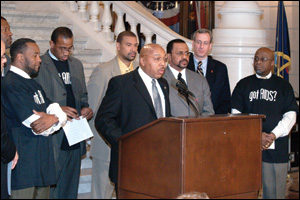
Legislators at the national, state and local levels recently wore black “Got AIDS?” T-shirts as part of a campaign to raise awareness of the AIDS epidemic in the black community. The Black AIDS Institute, a national policy organization based in Los Angeles, delivered the T-shirts to legislators with the question “Got AIDS?” on the front, and the response “How do you know?” on the back. The elected officials were asked to take photographs wearing the shirts to raise awareness of the impact of HIV/AIDS in the African-American community. The campaign coincided with the observance of National Black HIV/AIDS Awareness Day. Participating states included Alabama, California, Colorado, Illinois, Louisiana and Pennsylvania. Sen. Vincent Hughes, a Democratic Pennsylvania state senator, was one of the members of the state’s Legislative Black Caucus who participated in a press conference wearing the “Got AIDS” T-shirts. “I had a resolution passed commemorating the day. I put on my shirt while I was on the floor of the Senate while I was speaking on the resolution,” Hughes said. “Then afterwards, we had a press conference on the rotunda of the state capitol. About half of the members of the Black Caucus were able to participate in the press conference wearing their shirts. We had some other Caucasian members join us.” The Pennsylvania House also passed a resolution by a unanimous vote of 203-0 declaring Feb. 7 as National Black HIV/AIDS Awareness Day, Members of the Oklahoma Legislative Black Caucus also participated in a photo opportunity wearing the “Got AIDS” shirts in observance of National Black HIV/AIDS Awareness Day, with the photo distributed to media outlets throughout the state. “We wanted to become the voice of the African-American community,” said Jesse Harris, state facilitator of the Oklahoma Comprehensive Health Awareness and Maintenance Campaign. In addition, Sen. Constance Johnson (D) and Rep. Anastasia Pittman (D) introduced legislation to fund HIV/AIDS awareness activities. “We’re using the Feb. 7 date as a kickoff for an ongoing awareness campaign,” Harris said. Upcoming activities include an HIV/AIDS awareness day geared toward African-American women and girls on March 10 and HIV/AIDS programming during an annual health forum in April at Langston University, a historically black university in Langston, Okla. “The data itself speaks volumes. To ignore the data is to minimize the crisis we’re confronting,” he said. Raising awareness is also a priority in the Oakland, Calif., area, said Karen Stevenson, spokeswoman for Mayor Ron Dellums. Although Stevenson said she could not confirm if Dellums received or had an opportunity to wear the “Got AIDS” T-shirts, she said the mayor plans to partner with the Alameda County Public Health Department to raise awareness on HIV/AIDS. “The mayor absolutely has health as a priority issue. He has a huge awareness of HIV/AIDS, both here in this country and on the African continent,” Stevenson said. “We are early on in our administration, but we hope to partner with the public health department and raise the profile of health issues through the city, but that’s going to take some time.” While Oakland and other communities across the country are in the process of organizing HIV/AIDS awareness efforts. Philadelphia is one city that has taken a proactive stance on the issue, Hughes said. In December, the state legislature announced an initiative to increase the availability of rapid-results AIDS testing in Philadelphia. “In Philadelphia, about 40 to 60 percent of people don’t show up to get their results for the traditional tests. And that kind of reflects nationally -- nationally the average is about 30 percent,” Hughes said. “Once they get that consciousness to go ahead and take the test, they need to know [the results] immediately.” State officials are also expanding educational and testing initiatives at two of Pennsylvania’s historically black colleges, Cheyney and Lincoln universities. The initiatives are in part a response to a recent incident in which a prostitute solicited sex from at least 10 individuals on Cheyney’s campus during a two-day period, Hughes said. “When she was apprehended, it was discovered that she had medication for HIV and admitted that she was HIV-positive,” Hughes said. “We’ve had a major effort in terms of education and testing on campus.” Philadelphia’s African-American churches are also involved in awareness-raising efforts. Enon Tabernacle Baptist, one of the city’s mega-churches, will host a special event on March 6 during the national Black Church Week of Prayer for the Healing of AIDS. The event will include a performance by Hughes’s wife, actress Sheryl Lee Ralph, who starred in the original Broadway production of the musical “Dreamgirls.” Hughes added that raising awareness of the impact of HIV/AIDS on African-American communities among his colleagues in the Pennsylvania General Assembly, especially those who do not represent predominantly Black districts, is an ongoing challenge. “We have got to step up first -- Black leadership, brothers and sisters in neighborhoods and communities have got to step,” Hughes said. “When decide to step up for ourselves, it legitimizes our demand that others step up.”