BTAN New Orleans Fights HIV and Builds Power Among Local Youths
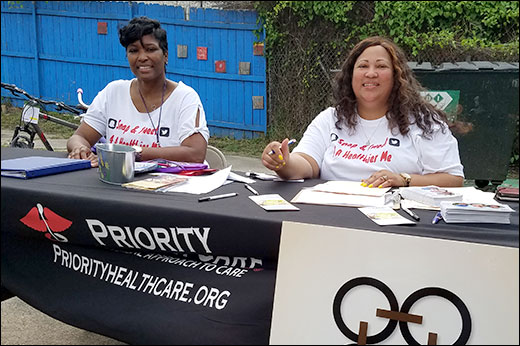
Tonja Walston and Karen Bennett at an outreach event
An afternoon in April 2017 found neighbors of all ages gathered outside a community center in Harvey, on New Orleans' West Bank. The scene was typical for a spring Friday in New Orleans: popular music on the speakers, a sno-ball truck at the curb, kids circling on bikes and skateboards.
The crowd had come to try their luck at raffles for bicycles or an iPad. To be eligible for the prizes, young people ages 13-20 stepped inside either to be screened for HIV and other chronic health conditions—or to play a bingo game featuring questions about sexual health.
"Even though the event was geared to the youth, we asked the younger ones to bring their parents, older siblings, neighbors, aunts," explains Tonja Walston, co-chair of the Black Treatment Advocates Network (BTAN) New Orleans, "so that we can educate them, and then they can have these conversations with their children."
The Segue to Communities
Nationwide, young people ages 13-24 made up 22 percent of new HIV cases in 2015, according to the most recent stats. In Louisiana, second in the nation in HIV rates, 26 percent of new diagnoses were in that age group. More than four-fifths of these youths were Black, and the proportion of newly diagnosed 13- to 19-year-olds who were Black climbed to 96 percent. Nearly a third of Louisiana's youth HIV cases that year occurred in New Orleans—the highest percentage for any area of the state. HIV rates are higher among people who have experienced incarceration, and Louisiana remains the incarceration capital of the U.S., and of the planet.
It's hard to know where to start, with statistics this daunting and health disparities this deeply entrenched. BTAN New Orleans' approach follows a key component of the first goal of the U.S. National HIV/AIDS Strategy: reducing new HIV cases, in part, by providing accessible, accurate HIV information.
Walston and her BTAN co-chair, Karen Bennett, are staff members at Priority Healthcare (PHC), a federally qualified health center that can see clients regardless of their ability to pay. Part of the aim of the event was to let community members know that PHC is there to provide for their overall health.
"HIV has such a huge stigma attached to it; once you add those other services, [they become] a segue between the clinics and the community," Walston explains. "Even though you may not have HIV, you may have these other things that can be just as deadly, or that you need to understand—diabetes, blood pressure; you need to make sure all of that is checked." Louisiana also leads the nation in these chronic health conditions; the bikes and Hula-Hoops in the raffle were intended to promote fitness as well as fun.
Youths Are Very Inquisitive
BTAN New Orleans leaders have found it relatively easy to engage area youths. "[Young people] are very open," Walston says. "Once they are comfortable with us and see that we listen—because we listen a lot; that's how we learn, and that's how we know what to turn around and teach—they are very inquisitive."
Bennett shares their knowledge by training students of a local historically Black college, Southern University at New Orleans, to become HIV advocates and educators in their own social circles. This summer, Bennett says, BTAN will host a movie day, featuring popcorn and the ever popular sno-balls, as well as HIV facts and testimonials by people living with HIV/AIDS.
"They want the information," Walston says. "We just have to get it out there to them."
Sex education and health promotion for young people are key components in bucking the trend in new HIV cases among this group. However, as Advocates for Youth—an organization for adolescent sexual health and rights—notes, factors rendering young people vulnerable to acquiring HIV are often beyond their control. Since studies show that differences in individual risk behavior do not account for the crushing HIV health disparities experienced by Black communities in Louisiana, steps to remedy these disparities must match the complex, systemic nature of the problem.
"People with backgrounds in health need to also understand: Don't let science be the only way," says Maxx Boykin, co-manager of the HIV Prevention Justice Alliance and a leader in BTAN's Chicago chapter. "We could have a cure and Black people would still be disproportionately impacted [in this epidemic] because of poverty, and racism within our education system.
"We do not end HIV without also ending these other pieces," he adds.
Organizing Builds Power
Black boys and girls, LGBTQ and gender-nonconforming youths, and those living at the intersections of these identities are overrepresented in criminal-justice involvement as well as in HIV rates. Anthoni (aka "Kym") Johnson is an organizer with BreakOUT!, an activist group in New Orleans that works with LGBTQ individuals ages 13-25 who have been directly affected by the criminal-justice system. "We deserve better as individuals and . . . a community. . . . Jobs, housing and education are our demands, and organizing around them builds power," Johnson says. Johnson defines "power" as "a heightened sense of responsibility that allows for us to set our goals and steps to achieve them."
"By taking ownership of our own lives," Johnson concludes, "we are more able to create spaces that address the HIV epidemic, and build collective understanding of health resources in community that will help us maintain a healthy lifestyle."
Walston of BTAN New Orleans concurs. "[Youth] have the power to empower as well—because they listen to each other," she says. "If we can get one to understand, that one can tell that one, and that one can tell the other one, and it will be a domino effect.
"Even though they're using treatment as prevention," Walston says, "we hope that we won't have to treat."
Olivia G. Ford is a freelance writer and editor based in New Orleans. She has been engaged with HIV-related media since 2007.