Blacks Lack Awareness of PrEP for Preventing HIV
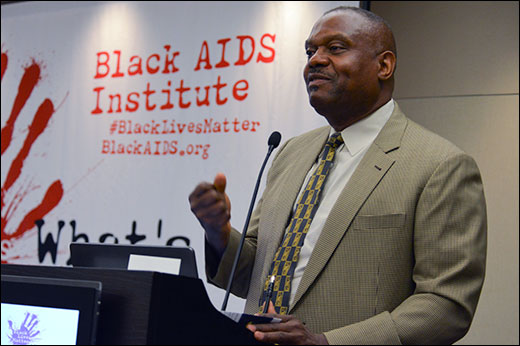
Eugene McCray, M.D., Director, Division of HIV/AIDS Prevention, National Center for HIV/AIDS, Viral Hepatitis, STD, and TB Prevention, CDC, speaks at the 2015 Black Treatment Advocates National Meeting
Leading up to the 2015 United States Conference on AIDS (USCA), the Black AIDS Institute hosted the National Black PrEP Summit to raise awareness about the new treatment that some AIDS activists have called a game changer in fighting the epidemic.
Studies have shown that pre-exposure prophylaxis (PrEP) reduces the risk of HIV infection by up to 92 percent for people who take the medicine consistently, compared to people who do not take it all.
Community stakeholders, health care advocates, HIV/AIDS researchers and physicians attended the day-long assembly featuring an overview of the latest PrEP research, a guide to the health-insurance marketplace and access to care, and sessions designed to share PrEP-uptake best practices with patients and health-care providers. Summit participants also met in smaller groups throughout the day to discuss a number of topics, including social and cultural issues affecting PrEP's adoption among different groups.
Despite PrEP's effectiveness in reducing the risks of HIV infection, Blacks, who are disproportionately affected by the AIDS epidemic, are less likely than Whites to have access to the life-changing drug.
In 2013, even though they account for a smaller share of the gay and bisexual population than Whites, Black men comprised 39 percent of HIV infections and the highest number of gay and bisexual men diagnosed with AIDS (5,804), outpacing the number of HIV infections and AIDS diagnoses for White men.
"Many Black gay men don't know about PrEP," said Ron Simmons, the executive director of Us Helping Us, People into Living, in Washington, D.C. "Most people, gay or straight, don't know about it. Doctors don't know about it."
Simmons continued: "A number of gay guys have said, 'I asked my doctor about it and he sent me to an infectious disease specialist.' And the infectious disease specialist says, 'I treat infections and you're not infected. You should be going to your primary care physician.'"
Just like a woman can go to her primary-care physician (PCP) to get a prescription for birth control, Simmons explained, your PCP should be able to write you a prescription for PrEP, with the understanding that you're going to come back in for a checkup every three months.
The PrEP Summit and the USCA are important platforms for sharing research and lessons learned from different parts of the country, said Simmons.
Simmons said that he was excited about the PrEP program implemented by the University of Alabama's 1917 PrEP Clinic that helps patients navigate PrEP use. He also noted that New York's governor, Andrew M. Cuomo, has also come out in support of PrEP as a part of the state's HIV/AIDS strategy.
"It's good that we get to share ideas," said Simmons. "Part of it is just getting people to understand what's out there."
Eric Anderson, a case manager for 15 years at the Evelyn Jordan Center, an HIV clinic at the Institute of Human Virology at the University of Maryland School of Medicine in Baltimore Md., said that he attended the PrEP summit because he was looking for ways to improve the PrEP program at his clinic.
"When I first heard about PrEP, I was kind of on the fence," said Anderson. "We already had people who didn't want to take their HIV medication. So how will you get people who are not sick to take medication?"
But in the last year or so, he has come around.
"It's nice to hand something out other than condoms that can protect people," said Anderson.
Anderson admitted that getting people connected to health insurance for PrEP and some of the messaging around the drug also needs to change.
"Instead of saying, 'this will stop you from getting HIV,' health-care workers and advocates should say, 'this will improve the quality of your sexual life,'" said Anderson. "PrEP is a hard sale because we sell it in the wrong way."
Simmons said insurance companies should be making it easier for patients to get on PrEP.
"Health insurance companies know that it's a lot cheaper to put you on a $12,000 a year pill than wait until you get HIV infected and you end up in the hospital with $500,000 in hospital bills," said Simmons.
Eugene McCray, M.D., the director of the HIV/AIDS Prevention division for the Centers for Disease Control and Prevention's National Center for HIV/AIDS, Viral Hepatitis, STD, and TB Prevention, says PrEP isn't for everybody.
"We need to make sure that people who are sexually active and at high risk also know the benefits of using condoms and the importance of having risk-reduction counseling," said Dr. McCray. "We really need to make sure the prevention toolbox has everything, including PrEP."
It's also important to change the narrative for people who take PrEP, said Dr. McCray.
"The stigma associated with PrEP is unfounded and it's really our job collectively to make sure we address that in the community and to make sure that people understand that PrEP works," said Dr. McCray. "It's not for everyone, but for people who want to use it, they should be able to use it. It doesn't devalue who they are and what they're doing."
Freddie Allen is the Senior Washington Correspondent for Black Press of America. You can follow him on Twitter @freddieallenjr.