Black AIDS Institute Brown Bag Webinar About Race Repeated by Popular Demand
The first in a series of stories covering the Black AIDS Institute's (BAI) quarterly Brown Bag Lunch Webinar series.
Each year the Black AIDS Institute hosts monthly Brown Bag Lunch Webinars that teach participants about a wide variety of topics related to ending the HIV/AIDS epidemic in Black communities. After each webinar, Black Treatment Advocates Network chapters provide corresponding programming in their local communities. This year the webinars will follow a quarterly theme. The first-quarter theme is Race, Class and Privilege.
The Jan. 9, 2017, kickoff session, "Race, Class and Privilege 101" (RCP 101), was over-subscribed, so it was offered again on Jan. 27. The first in a three-part monthly series, RCP 101 is intended to help the community, HIV care providers and advocates understand how concepts not conventionally considered in relation to HIV care not only affect people living with HIV (PLWHA) but also help drive the epidemic in Black communities. Participants in all three first-quarter webinars will:
- develop a deeper understanding of these topics;
- learn strategies to combat stigma;
- be able to recognize privilege and identify strategies to create equity through HIV testing, linkage and care programming;
- increase cultural competence around the causes of racialized health disparities, including medical mistrust; and
- improve the wider community's understanding of how race, class and privilege impact HIV.
Complicate the Conversation
We know that HIV does not discriminate. And yet health disparities based on race, class and privilege exist, including in the HIV treatment cascade. According to the Centers for Disease Control and Prevention, the lifetime risk of HIV infection for a Black MSM is 1 in 1; 1 in 20 Black men and 1 in 48 Black women are likely to receive an HIV diagnosis within their lifetime.
In the second webinar, its creator, Ja'Nina Garrett Walker, Ph.D., a psychology professor at the University of San Francisco, joined Black AIDS Institute Director of Programming Raniyah Copeland and Institute Mobilization Manager Erica Lillquist to discuss topics such as systems of oppression, privilege, race and ethnicity, racism, class structure, and intersectionality. These issues were explored in both their historical and contemporary contexts to help organizations develop programs that alter the disproportionate ravages of HIV in Black communities.
In her presentation, Dr. Walker defined "privilege" as it is used within racial and social-justice contexts. She discussed different forms of privilege, how privilege plays out individually and structurally, and the fact that most of us have access to some form of privilege. Then she challenged participants to consider privilege through the lenses of race, ethnicity and class. Dr. Walker also stressed pushing back against privilege by, among other things, teaching privileged people about their privilege in ways that don't make them defensive, so that they can transform themselves into soldiers against oppression.
Think Big Picture
All three presenters discussed how race, ethnicity, class and other factors come together in a person's entire life experience and why they must be considered when one is gathering data from PLWHA, since their privilege or oppression will influence factors such as whether health care is readily accessible in their neighborhoods, whether health-care providers look like them and whether they've had negative experiences with those providers. Influences in other areas of their lives may also affect their linkage to care.
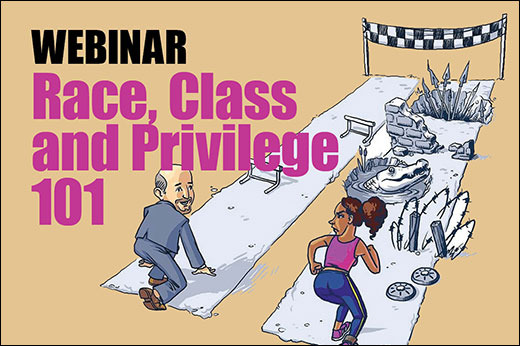
To demonstrate the importance of intersectionality, in one example given, two PLWHA were compared: a wealthy White gay male living in an urban area, and a poor Black, Christian heterosexual woman who has children. In the case of the White male, he is privileged as a White man with economic resources and access to health-care systems staffed with health-care providers who look like him; however, he may face oppression and stigma with regard to his sexual orientation and HIV-positive status. The Black woman is privileged as a Christian and as a heterosexual person; however, as a poor black woman with children and HIV, she can face stigma and oppression, including in some Christian circles. She also may not have access to health-care facilities that meet her travel and time constraints.
Dr. Walker advises that we think "big picture" when considering individuals who hold marginalized identities. "If we do not discuss the structural barriers that they face on a day-to-day basis, we are missing an integral part of their lived experiences and how those barriers impact their health," she says. "In order to effectively serve a community that is so disproportionately impacted by HIV, we must acknowledge and help deconstruct the structural inequalities that may be impacting their overall physical and mental health. These conversations must happen in our primary and secondary prevention efforts."
April Eugene is a Philadelphia-based writer.