Anthony S. Fauci: The Government's Key Weapon in the Fight Against HIV/AIDS
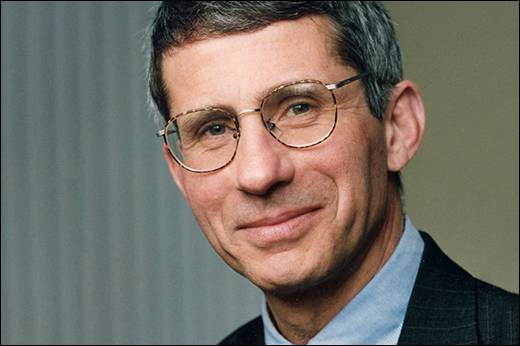
The first in a series of profiles about the 15th Anniversary Black AIDS Institute Heroes in the Struggle Gala Reception and Awards Presentation honorees.
It's been said that the end of the HIV/AIDS epidemic is in sight. But without the research and leadership of Anthony S. Fauci M.D., the idea of an AIDS-free generation would likely still be a pipe dream.
As the director of the National Institute of Allergy and Infectious Diseases (NIAID) since 1984, Dr. Fauci oversees research into the prevention, diagnosis and treatment of HIV/AIDS as well as other infectious diseases. A key adviser to the White House on global AIDS issues, Dr. Fauci has been the federal government's point man in the fight to end the epidemic. It's a role he has taken seriously from the beginning, even when some did not think that HIV/AIDS warranted a substantial amount of government resources and others wanted to ignore the disease because it affected the most disenfranchised members of society.
In an interview with The Washington Post, Dr. Fauci described having to convince some of his colleagues in the early 1980s that there needed to be a major effort on research into the newly discovered HIV virus because "I saw this disease as an exploding problem." His foresight proved to be correct. The number of HIV/AIDS-related deaths around the world rose steadily each year until 2005, when 2.3 million people died as a result of the disease.
In 2002 President George W. Bush asked Dr. Fauci to go to Africa to help come up with the outline for the President's Emergency Plan for AIDS Relief, or PEPFAR. That historic initiative became the largest effort by any nation to fight a single disease on a global level, and it is credited with saving millions of lives around the world.
Prolific in his research, Dr. Fauci was the 10th-most-cited HIV/AIDS researcher in the world from 1996 through 2006. Much of his research has had to do with how HIV actually affects the body. He has explored and explained just how the virus attacks the immune system, leaving the body vulnerable to deadly infections. His research has also been instrumental in developing the treatment strategies that have proved to be the most effective. And he has worked toward the day when HIV/AIDS not only would be successfully treated but also would be prevented in the first place.
In Search of a Vaccine
One of Dr. Fauci's key interests has been the search for a vaccine, which he says would do more to end the HIV/AIDS epidemic than any other strategy or tool.
In a Washington Post opinion piece in 2013, Dr. Fauci wrote: "Mathematical models suggest that, by implementing existing HIV/AIDS treatment and prevention tools much more broadly worldwide, we can reach an AIDS-free generation. But without an effective HIV vaccine, reaching that goal will take much longer and will be more difficult, and along the way more people will become infected and more lives will be lost."
A vaccine would be so monumental that it needn't be 100 percent effective, Dr. Fauci wrote: "An HIV vaccine need only hit that sweet spot—perhaps 50 percent to 70 percent effective—that, when combined with other prevention tools, provides a highly effective prevention strategy." A vaccine also would be the greatest factor in maintaining an AIDS-free generation over time, Dr. Fauci says.
When one considers his background, it's little surprise that Dr. Fauci would become a champion for health. Born in 1940 in Brooklyn, N.Y., to Stephen and Eugenia Fauci, he has stated that public service was always a priority to his parents. Even the Jesuit institution, Regis High School, that he attended reflected that ideal. But it wasn't the only interest he inherited. There was also a family connection to health and medicine: His father was a pharmacist who owned a neighborhood drugstore. "I was delivering prescriptions from the time I was old enough to ride a bike," Dr. Fauci told Holy Cross Magazine.
Dr. Fauci attended the College of the Holy Cross and in 1966 received his M.D. from Cornell University Medical College. After leaving Cornell, he did his residency at the New York Hospital-Cornell Medical Center.
In 1968 he began his career at the National Institutes of Health, first as a clinical associate in the Laboratory of Clinical Investigation in NIAID. He became head of the clinical-physiology section in 1974, and in 1980 he became chief of the Laboratory of Immunoregulation, a position he still holds today.
Dr. Fauci has received numerous awards for his work, including the Presidential Medal of Freedom, the National Medal of Science, the George M. Kober Medal of the Association of American Physicians, the Mary Woodard Lasker Award for Public Service, the Albany Medical Center Prize in Medicine and Biomedical Research, the Robert Koch Gold Medal, the Prince Mahidol Award and 38 honorary doctoral degrees from universities across the globe.
Despite the accolades, Dr. Fauci indicated at the 2012 International AIDS Conference that he has no plans of stopping "until finally we can say that we are the generation that opened the door, through our scientific endeavors and our implementation, to an AIDS-free generation."
The 15th Anniversary Black AIDS Institute Heroes in the Struggle Gala and Awards Presentation will be held on Tuesday, May 20th, 2014 at 7 p.m. at the Directors Guild of America in Los Angeles. To purchase tickets click here.
Tamara E. Holmes is a Washington, D.C.-based journalist who writes about health, wealth and personal growth.