AIDS 2014: The Role of Civic Engagement in HIV Treatment and Prevention
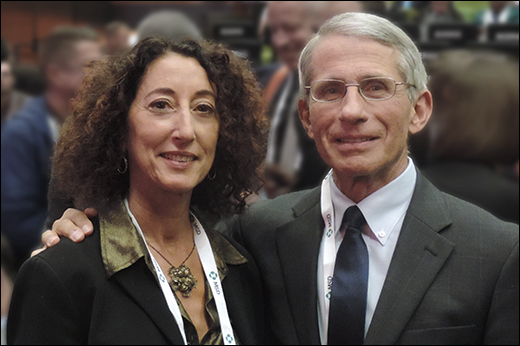
Drs. Judith Auerbach and Anthony Fauci
Melbourne, Australia – Judith D. Auerbach, Ph.D., adjunct professor at the University of California, San Francisco, and Veronica Noseda of France moderated a panel of distinguished social scientists exploring the technological, behavioral, social, political and economic factors that impact people's decisions to participate in HIV prevention and treatment programs.
All of the panellists acknowledged the challenges that researchers face when conducting clinical trials, a type of health research involving experiments on humans. Panel members discussed a range of topics, including the allegations that some HIV research exploits vulnerable populations.
According to Kathleen MacQueen, Ph.D., an adjunct associate professor at the Gillings School of Global Public Health at the University of North Carolina and senior scientist at FHI360, a non-profit human-development organization, these controversies "can be viewed as an expression of civil engagement in science." She is a developer of the "Stakeholder Engagement Toolkit for HIV Prevention Trials" (pdf), a 224-page publication designed to facilitate researchers' work within the communities in which these clinical trials are conducted.
Pedro Goicochea discussed his recent study (pdf) of factors associated with the use of antiretroviral medications as pre-exposure prophylaxis (PrEP). According to Goicochea information was collected from 2,499 participants through interviews and discussion groups. Among the most important factors motivating people to participate in the clinical trial was their ability to receive health services. He also learned that participants wanted the treatment to continue after the clinical trial ended, raising the question of the availability of post-experiment treatment.
Kane Race, Ph.D., an associate professor of gender and cultural studies at the University of Sydney in Australia, began his presentation by stating, "greater public understanding of science is essential for modern democracy." He emphasized that public engagement with HIV care is different than public engagement with science.
Kenyon Farrow, US and global health policy director of the Treatment Action Group based in New York, was among the session's attendees. Farrow said that people living with HIV and people in communities impacted by HIV are stakeholders in clinical trials. He contends that African Americans can engage publicly with HIV science to the extent they are informed about its advancements. HIV prevention advocates can increase their informational activities, including regularly contacting civic groups, youth organizations, and faith-based associations located within African American neighborhoods, he says.
Anne T. Sulton, J.D., Ph.D., is the senior international correspondent for the Jackson Advocate.