AAHU Fellow Aaron Davis: Break It Down so People Can Understand
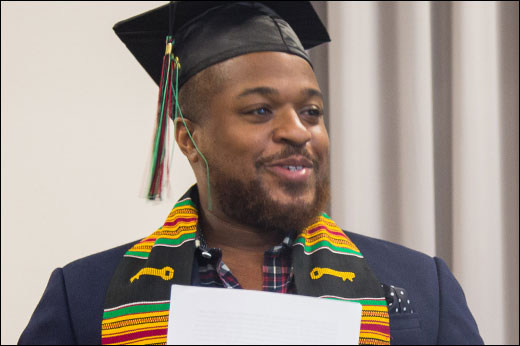
AAHU Fellow Aaron Davis
One in a series about recent graduates of the African American HIV University (AAHU).
As a premed major in college, Aaron Davis, AAHU's 2016 valedictorian, admits to having an advantage over the other Fellows in the science and treatment training, although he insists that it was not an unfair one.
"I graduated from Wittenberg University in the top three in my biology major, so I definitely had an advantage when it came to how I gathered information and how I interpreted it," says Davis. "But when it came to learning about the genetics and research and vaccines, the technical stuff, having that background did help in my understanding of it."
Davis was on his way to medical school before being diagnosed HIV positive at the age of 23.
Like many others, he received his results through a rejected health insurance application. That diagnosis changed his career path. "For me, getting into this field was really personal. I didn't want what happened to me to happen to other people," he says. Now he devotes his efforts to preventing the spread of the virus and helping people living with HIV/AIDS (PLWHA) live as healthily as possible.
Wanting to see more of the world, he applied for jobs outside of Springfield, Ohio, where he grew up and attended college. In 2006 he landed a position at Johns Hopkins University in Baltimore as a community research assistant. There he facilitated a community-research study focused on African American MSMs.
When the study ended, Davis took his skill set as a health facilitator to the Maryland Department of Health and Mental Hygiene for two years before being promoted to program manager. After beginning with a few small programs, today Davis monitors the HIV testing and prevention programs of county health departments and community organizations throughout the state, and provides technical assistance to staff and capacity building.
"As a program manager I had many aspects of programming, but I had never planned programs from the ground up," Davis says. "AAHU gave me a better understanding of the complete process."
He also credits the training with helping him to effectively communicate science and treatment information to laymen. "At AAHU there were professors that I think oftentimes forgot that, for the most part, they were dealing with a population of people who may not have a science background; we weren't doctoral students," he says. "As a program manager explaining HIV to other people, I have to remember that in the back of my head and not to speak always in technical or medical jargon, but to break it down into more relatable words that people can understand."
Davis used his post-AAHU trainings to help relaunch the Black Treatment Advocates Network in Maryland. The initial push is in Baltimore, which has the state's highest HIV rate, followed by other parts of the state, most notably the suburbs surrounding Washington, D.C., where HIV is also prevalent.
"Maryland is definitely plagued by HIV more than other states, with a lot of the data now showing that we're No. 2 nationally; and because we're in close proximity to D.C., which has a high HIV rate, we experience a high rate of new infections. Going through AAHU gave me the opportunity to bring back what I learned from the fellowship and apply it to the relaunching of our chapter."
Davis says that AAHU is definitely worth it. "Even through those times when you don't feel like going to class, the reward that you get out of it is worth more than any headache that you might have during it. Trust the process and do it. Don't let your hesitation stop you, because I have gained so much, and I can never thank them enough for that opportunity."
April Eugene is a Philadelphia-based writer.