Mobilization
By Sharon Egiebor
Fifty-four women’s organizations, representing 4 million African American women across the U.S., have pledged to take action to reducing the impact of HIV/AIDS on the black community within five years. The organizations made the commitment during the second annual “M.E.E! (Mobilization, Education, Empowerment) Sistahs Getting Real About HIV” conference held recently in Los Angeles. According to the pledge, the groups – both national and based in California – will make HIV/AIDS in black women a top three agenda item, will personally encourage HIV testing and education among its members, and will participate in letter writing campaigns to local, state and national politicians asking them to increase the level of HIV/AIDS funding beyond the federal Ryan White Care Act. The groups signing the pledge included sororities, medical associations, civic societies, education bodies and religious organizations. “It is important to keep this issue in front of African American women, who represent 70 percent of new HIV cases among women in America,” said Cheryl Cooper, president of the National Council of Negro Women. “Until we change those statistics dramatically, we need to keep these statistic in front of our women, along with the new technology, new treatment and other tools available to help African American women protect themselves from this disease. Once they have contracted the disease, we want them to live a quality life.” Cooper said NCNW officials would meet to develop an internal strategy before developing specific community programs. The Black AIDS Institute, the National Council of Negro Women, and the National Coalition of 100 Black Women jointly hosted the conference. “African American women cannot afford to stay out of this fight. It is killing us disproportionately and we have to educate ourselves so that we can save ourselves,” Cooper said. According to the Centers for Disease Control and Prevent, AIDS remains one of the leading causes of death for African Americans in the United States. With regard to Black women in the U.S: AIDS is the leading cause of death for Black women between the ages of 24-34; Black women account for 69 percent of new HIV/AIDS cases among women; and Black women are 19 times as likely as white women to have HIV/AIDS and 13 times more likely to die from the disease. The conference, held at the Omni Hotel from Feb. 7-11, targeted leaders from women’s organizations. The sponsors included MAC AIDS Fund, amFar and the U.S. Office of Women’s Health. “This conference is important because it is the only conference of its kind that commits four days to educating, exploring and then processing and leaving participants with critical next steps in how we address HIV and AIDS as an opportunistic disease in our community,” said Grazell Howard of the National Coalition of 100 Women. “Along with the other challenges we have in our community that is around sex, power and access. We spent four days on the topic in a way that people could leave the conference with tools, in some cases turnkey tools,” said Howard, conference co-chair. Topics ranged from the do’s and don’ts of HIV medications and prevention strategies to panel discussions with heterosexual men and the role they play in spread or preventing the spread of this disease to youth speaking to older generations. “One of the great things this year was this intergenerational discussion on sex, sexuality, and HIV/AIDS, as well as socialization and parenting,” said Howard, who sat at a table with 14-year-olds during the discussion. Alabama State Rep. Laura Hall, D, whose 23-year-old son died in 1992 from complication of AIDS, was on a panel with other mother’s whose children had or have the disease. “We suffered in silence until three months before his death. When he realized he wasn’t going to get any better, his request for me and his dad was that we do everything so that no one else will suffer,” said Hall. ”Once we told people, friends and family members, everybody just rallied around him. He realized at that point how much better it would have been for us and him if we had that support the whole time.” Hall, who is a Black AIDS Institute board member, said she and her husband spend a lot of time participating in AIDS awareness programs and that a
With her insistence, Alabama’s AIDS Drug Assistance Program funding increased from $150,000 in 1998-99 to $6 million in 2006, she said.
The role of religion and the religious community Religion in the fight against HIV/AIDS also were discussed during the conference. “The faith-based communities really are our lynchpin and they are not engaged in a way that can be impactful and effective,” said Howard. “If the church put the issue on the forefront of the agenda, that would help immediately and you would have the removal of stigma, you would have people speaking testaments and you would have another vehicle for spreading accurate information around prevention.” Yvette Heyliger, a New York poet and playwright, presented two sessions on “What Would Jesus Do.” The plot centers on an unfaithful husband and a praying wife. The wife attends a conservative church that struggles to respond to her emotional and spiritual needs. At the end of the play, the church hosts its first HIV/AIDS prevention program. “The play challenges the church to do more with HIV/AIDS; to challenge convention, to openly discuss sexuality issues, which are not discussed in the church period. It really challenges the church to do more,” said Heyliger, who produces the plays with her twin sister Yvonne. “I know that it is set in the church but not just Christians can appreciate the play. Anyone in life can appreciate the message.”
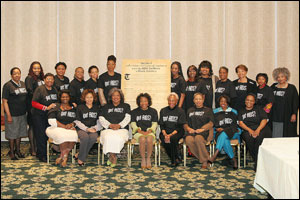
54 Women's Organizations Issued a Call to Action during the M.E.E.! Sistahs Getting Real About HIV Conference held in Los Angeles, Calif. from Feb. 7-11, 2007.
National Organizations:
National Council of Negro Women
National Coalition of 100 Black Women, Inc.
Alpha Kappa Alpha Sorority
Auxiliary of the National Medical Association
Beta Pi Sigma Sorority, Inc.
Chi Eta Phi Sorority
Chums Inc.
Continental Societies
Delicados Inc.
Delta Sigma Theta Sorority, Inc.
Eta Phi Beta Sorority, Inc.
Gamma Phi Delta Sorority
Grand Temple Daughter of Elks
Iota Phi Lambda Sorority, Inc.
Ladies Auxiliary, Knights of Peter Claver
Ladies Auxiliary, National Dental Association
Lambda Kappa Mu Sorority
Las Amigas, Inc.
Les Gemmes, Inc.
National Associationof Fashion & Accessory Designers
National Association of Negro Business & Professional Women's Clubs
National Association of University Women
National Black Nurses Association, Inc.
National Grand Chapter, Order of Eastern Stars
National Sorority of Phi Delta Kappa
National Women of Achievement, Inc.
Pi Omicron Rho Omega Sorority
SCLS Women
Sigma Gamma Rho Sorority
Tau Gamma Delta Sorority
The Charmettes, Inc.
The Women's Convention auxiliary of the National Baptist Convention
Top Ladies of Distinction, Inc.
Trade Union Women of African Heritage
Twinks Social and Civic Club, Inc.
Woman's Home & Overseas Missionary Society, AME Zion Church
Women's Missionary Society, AME Church
Women's Missionary Council, CME Church
Women's Lawyers Division, National Bar Association
Zeta Phi Beta Sorority
Local Organizations:
Los Angeles Bind
Los Angeles Branch of Women of the NAACP (WIN) Los Angeles Chapter of the National Coalition of 100 Black Women Inc.
The National Association of Black Women Physicians
Los Angeles District, United Methodist Church
National Association of University Women
MU Lambda Omega chapter of Alpha Kappa Alpha
Black Nurses Association
Coalition of Mental Health Professionals
Association of Black Women Lawyers
Southwest College
Black Women's Network
Black Women's Forum
Rolling Hills Chapter, Delta Sigma Theta Inc.